
AI saves the most time when it becomes part of your actual workflow, not just another tab you occasionally open. The three highest-leverage uses in my business: let AI run your meal planning and grocery list, analyze your backend data weekly, and mine your client calls for content and offer ideas. Track your time first to find what to automate.
Listen to ‘How I’m using AI to save me 3 hours a week in 3 different areas of my digital product business’ on: Apple Podcasts | Spotify | Your player of choice
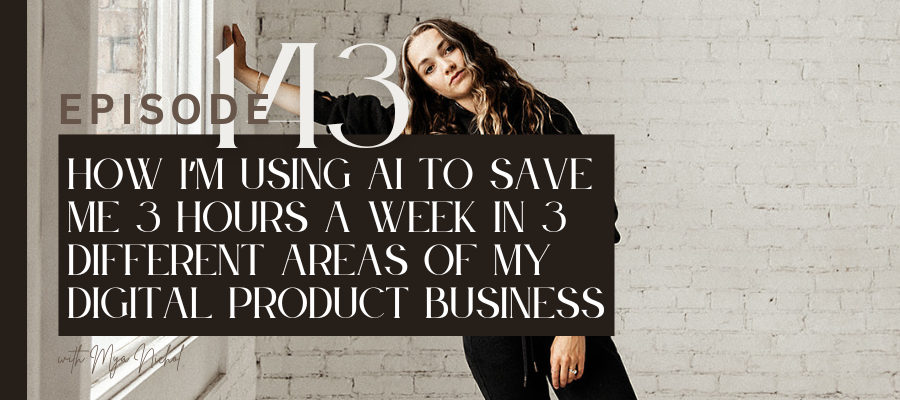
In today’s episode, I’m breaking down how AI is actually saving me time in my business and personal life instead of creating more work. I’m sharing why I almost gave up on AI completely, what changed when I started using Claude Co-Work, and the exact ways I’m using it to automate repetitive tasks, analyze data, streamline my backend systems, and even help with meal planning at home.
We’re also diving into the 5 levels of AI usage, why most people are stuck at level one, and how to start thinking about AI as more than just a chatbot. If you’ve been curious about AI but overwhelmed by all the noise online, this episode will help you think about it in a much more practical, sustainable, and business-focused way.
What you’ll learn
- The 5 levels of AI usage and why most people never move past basic prompting
- Why Claude Co-Work completely changed the way I use AI in my business
- How I use AI to automate meal planning, grocery ordering, and reduce food waste
- Ways AI helps me analyze ads, Google Analytics, podcasts, and social media content
- How I “message mine” client calls and conversations for content, offers, and messaging ideas
- A simple exercise to identify which tasks you should automate first with AI
3 Unexpected Ways AI Is Helping Me Work Less and Scale Smarter
There was a point earlier this year when I almost gave up on AI completely.
Not because I didn’t believe in it. Not because I thought it was overhyped. But because it genuinely was not saving me time.
If anything, it was slowing me down.
I’d spend forever rewriting prompts, regenerating outputs, tweaking copy, and trying to make the content sound remotely human. What was supposed to save me time was actually taking me two to three times longer than doing the work myself.
And as someone whose entire business is built around working less, scaling sustainably, and creating more freedom… that felt incredibly frustrating.
Then everything changed when I started using Claude Co-Work.
Now, AI is saving me around five hours a week across my business and personal life.
Today, I want to break down three specific ways I’m using AI to save at least one hour a week in three different areas of my digital product business — and why I think most entrepreneurs are barely scratching the surface of what AI can actually do.
Most Business Owners Are Using AI at a Level 1
Before I get into the exact workflows, I want to explain something that completely shifted how I think about AI.
Most people are only using AI at the very first level.
That looks like:
- Opening ChatGPT
- Typing a prompt
- Getting an answer
- Copying and pasting the output somewhere else
That’s it.
And honestly? That’s where I was stuck too.
The problem is that this barely scratches the surface of what AI can actually do for your business.
Once I realized there were deeper levels of AI integration — automation, assistants, workflows, and full operating systems — everything clicked.
Instead of simply asking AI questions, I started having AI actually do work for me.
That’s the difference.
1. Using AI as My Personal Assistant to Meal Plan and Grocery Shop
This is probably one of the most practical ways I’m using AI right now.
I love cooking.
I absolutely hate grocery shopping and meal planning.
So I had Claude study:
- My previous Instacart orders
- The meals I cook regularly
- Family recipes
- Recipe blogs I already love
- Foods my family enjoys eating
Then I created a recurring workflow where every Sunday, AI:
- Creates my weekly meal plan
- Plans lunches and dinners
- Accounts for leftovers
- Minimizes food waste
- Rotates ingredients efficiently
- Suggests one new recipe each week
- Builds my Instacart grocery list automatically
All I do now is quickly review the order and hit submit.
What used to take me an hour every week now takes maybe five minutes.
And honestly, the biggest benefit isn’t even just the time savings.
It’s removing mental load.
As entrepreneurs, we often underestimate how much energy gets drained by repetitive decisions. AI has helped me eliminate an entire category of invisible work from my life.
2. Using AI to Analyze the Backend of My Business
This is where I’m probably saving the most time overall.
Every week, AI reviews and analyzes:
- My ads
- Google Analytics
- Instagram performance
- Podcast content
- Social media trends
Instead of manually digging through dashboards and data, AI gives me a summarized report showing:
- What’s working
- What isn’t working
- Opportunities for improvement
- Areas to scale
- Trends I should pay attention to
And honestly, this is especially helpful with platforms like Google Analytics because there’s so much data inside of it that it can feel overwhelming trying to interpret it all manually.
Now I can focus on making strategic decisions instead of spending hours collecting and organizing information.
That distinction matters.
Because as business owners, our highest-value work usually isn’t data collection.
It’s decision-making.
AI helps bridge that gap much faster.
3. Using AI to “Message Mine” Client Conversations
This might be the most valuable workflow I’ve built so far.
One of the biggest struggles I hear from business owners is:
- “I don’t know what content to create.”
- “I run out of ideas.”
- “I don’t know how to improve my messaging.”
Meanwhile, we’re sitting on an endless amount of market research every single week through client conversations.
Most people just aren’t using it.
Now, every time I host a mastermind call, coaching session, or client conversation, AI reviews the transcripts and extracts:
- Recurring questions
- Common pain points
- Exact client language
- Content ideas
- Offer opportunities
- Messaging insights
- FAQ patterns
- Product ideas
It also keeps a running database of trends across all conversations over time.
This means AI can tell me things like:
- “You should build an offer around this topic.”
- “This question keeps coming up.”
- “Clients are consistently struggling with this step.”
- “This language would perform well on your sales page.”
And honestly, this has completely changed the way I think about content creation.
Because now, instead of guessing what my audience needs, I’m building content directly from real conversations.
That makes the messaging significantly stronger.
The Biggest Lesson I’ve Learned About AI
Just because AI can do something doesn’t mean it should.
I think that’s where a lot of people get stuck.
When I first started using AI more seriously, I fell into the shiny-object trap hard.
I’d see someone online saying:
- “AI can build an app!”
- “AI can do this!”
- “AI can automate that!”
And suddenly I’d spend hours experimenting with random things that weren’t actually helping my life or business.
Now, I approach AI very differently.
Instead of asking:
“What cool things can AI do?”
I ask:
“What tasks consume the most time and energy in my business?”
That question changes everything.
Because the best AI workflows aren’t necessarily the flashiest ones.
They’re the ones that quietly remove friction from your everyday life.
How to Start Using AI More Strategically
If you want to use AI in a way that genuinely saves you time, here’s my biggest recommendation:
Track everything you do for one week.
Seriously.
Use a free time-tracking app and document:
- Repetitive tasks
- Administrative work
- Content workflows
- Email management
- Research
- Planning
- Reporting
- Client communication
Even the tiny tasks matter.
Because once you can clearly see where your time is going, it becomes much easier to identify what AI should automate first.
Most people are trying to force AI into random workflows.
Instead, let your actual habits reveal the opportunities.
That’s where the real time savings happen.
Final Thoughts
AI has gone from being something that frustrated me to something that genuinely supports the way I work and live.
Right now, it’s helping me:
- Save time
- Reduce mental load
- Improve decision-making
- Strengthen messaging
- Create better offers
- Scale more sustainably
And I honestly feel like I’m still only scratching the surface.
The biggest shift wasn’t finding “better prompts.”
It was realizing AI works best when it becomes part of your workflow instead of just another tool you occasionally open in a browser tab.
That’s when things really start to compound.
And for me, that’s when AI finally started delivering on the promise of actually saving time..
Frequently asked questions
How can AI save time in a small business?
AI saves time when it’s built into your actual workflows instead of used as an occasional chatbot. The highest-leverage uses are automating repetitive admin, analyzing data you’d otherwise dig through by hand, and pulling content and offer ideas from client conversations. Track your time for a week to spot what to automate first.
What are the five levels of AI usage?
Most people use AI only at level one: opening a chatbot, typing a prompt, and copying the answer somewhere else. The deeper levels move into automation, AI assistants, built workflows, and full operating systems, where AI actually does the work for you instead of just answering questions.
How do I decide which tasks to automate with AI?
Track everything you do for one week with a time-tracking app, including the small tasks. Once you can clearly see where your time goes, the tasks worth automating become obvious. Let your real habits reveal the opportunities instead of forcing AI into random workflows you saw online.
Can AI help with meal planning and grocery shopping?
Yes. You can have an AI tool study your past grocery orders, regular meals, and favorite recipes, then build a recurring weekly workflow that creates your meal plan, accounts for leftovers, minimizes food waste, and builds your grocery list automatically. It removes the time and the mental load.
How can AI help analyze my business data?
AI can review your ads, analytics, social media performance, and content each week and return a clear summary of what’s working, what isn’t, and where the opportunities are. That frees you to focus on decision-making, your highest-value work, instead of manually collecting and organizing data.
What is message mining with AI?
Message mining is having AI review transcripts of your client calls, coaching sessions, and conversations to extract recurring questions, exact client language, pain points, content ideas, and offer opportunities. It turns the market research already happening in your conversations into stronger content and messaging.
Why does AI sometimes waste time instead of saving it?
AI wastes time when you chase flashy use cases or fight with prompts and outputs. It saves time when you stop asking what cool things AI can do and start asking what consumes the most time and energy in your business. The best workflows quietly remove friction.
Resources & Links:
- Manychat: 50% off for 2 months
- Join Stacked Inbox
- Join Scalability
- 30 free selling on stories prompts
- Scaling Unlocked Mastermind Application
- Kajabi 30-day free trial + 2 bonuses
- Manychat
- IG University
Some of the links mentioned are affiliate links, which help to support this podcast at no additional cost to you.
Connect with Mya:
- Follow on Instagram @myanichol
- Join my email list
- Check out my website
- Now on YouTube
More about the Radical Disruption podcast:
Are you wanting to make waves in your industry, push the envelope, and change the way things are done in a radical way? Are you looking for tangible, tactical, and actionable steps that will help you build a sustainable business that stands out? You’re in the right place!
Radical Disruption is home to the disrupters. Here, you’ll learn how to take your business to the next level, break the status quo, and build a disruptive business.
Nursing student turned business and social media expert and host Mya Nichol (hey, that’s me!) shares the real and raw of the crazy journey of entrepreneurship and building a multi-six-figure business.
Through solo episodes and special guest interviews, you can expect honest conversations about throwing out the traditional way of business, scaling in a sustainable way, and becoming the go-to expert in your industry. It’s time to build a disruptive business. See you on Tuesdays!
Make sure to hit subscribe/follow so you never miss an episode!